 La Sagrada Familia Tours
The Best Time to Visit the Sagrada Família
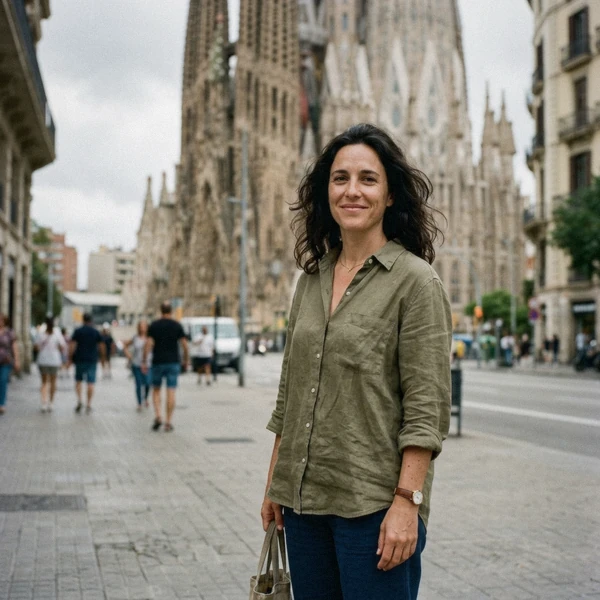
The best time to visit Sagrada Familia is the first hour after opening or the last two hours before it closes, in November, February or late October rather than in August. Those windows exist because of the glass: the eastern windows are blue and green and burn for about two hours after 9:00, and the western ones are orange and red and take over from around 16:00. In between, the nave is bright, busy and much less interesting. I live four Metro stops away and have been in at every hour the basilica sells, in every month of the year. This is what each one is actually like.
Quick answer
Go at 9:00 for the blue eastern glass and the daily Quiet Hour, or take the last slots of the afternoon from about 16:00 for the amber western glass. By month, November to February is quietest and closes at 18:00; April to September stays open to 20:00 but is crowded and hot. Saturday closes at 18:00 in every season and Sunday does not open until 10:30 because of the 9:00 Mass.
Key takeaways
- Hours: 9:00 to 18:00 from November to February, 9:00 to 19:00 in March and October, 9:00 to 20:00 from April to September
- Quiet Hour runs 9:00 to 10:00 every day since February 2026: earphones required, voices down, and the calmest slot on sale
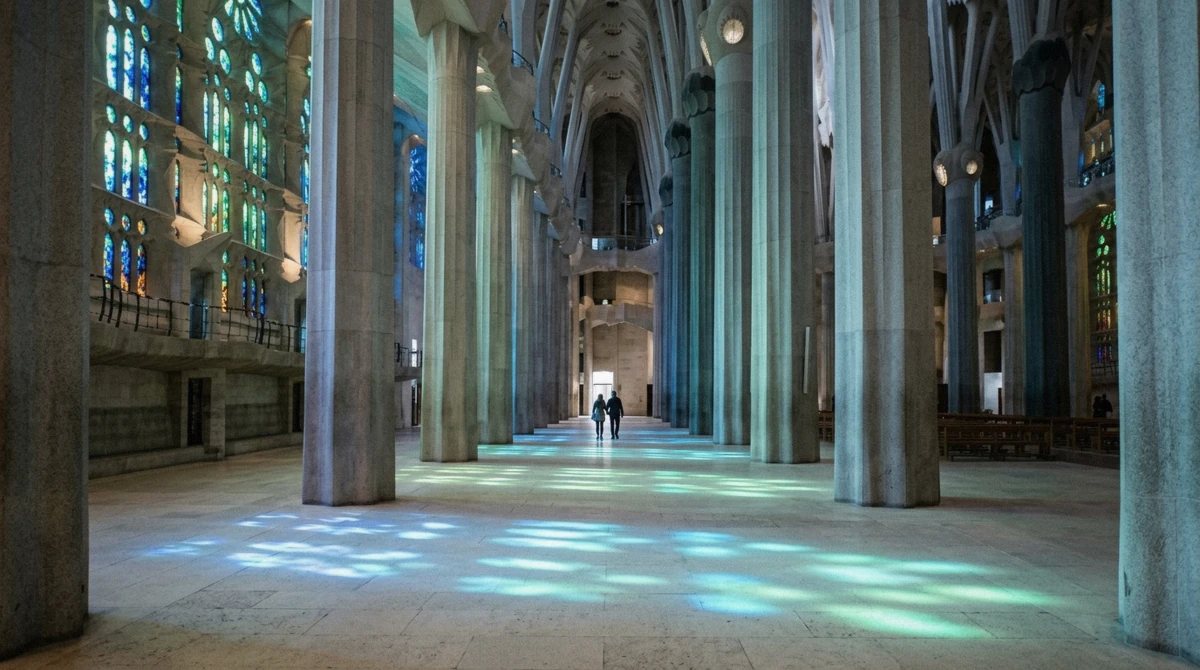
- Blue eastern glass roughly 9:00 to 11:00, amber western glass from about 16:00, best of all in the last hour of a summer evening
- Saturday always closes at 18:00; Sunday opens at 10:30, after the free 9:00 international Mass
- Quietest months are November to February, excluding Christmas week; August is the worst on both crowds and heat
- Dress code is enforced: shoulders and knees covered, hats off inside. Jeans are perfectly fine
The Year at a Glance
Hours come from the basilica's own schedule. Crowd levels are what I see on the ground and in how far ahead the morning slots disappear.
| Season | Closing time | Crowds | Book | Booking lead | Verdict |
|---|---|---|---|---|---|
| November to February | 18:00 | Lightest | A day or two | Best overall, short afternoons | |
| March and October | 19:00 | Building | About a week | Good compromise, watch for Easter | |
| April to September | 20:00 | Heavy | One to two weeks | Long evening light, hot and full | |
| 25 to 26 December, 1 and 6 January | 14:00 | Mixed | Days ahead | Half days only, plan around them |
One line under the table that matters more than the table: whatever the season, Saturday closes at 18:00 and Sunday opens at 10:30.
Season by Season
November to February: the Quiet Months
This is when I take visiting friends. The basilica closes at 18:00, which sounds restrictive until you realise the sun sets around 17:30 in December, so the western glass does its work at 16:00 instead of 19:00 and you get the whole show in the afternoon slot.
Crowds are the lightest of the year outside Christmas week. Morning slots are usually available a day or two ahead, sometimes the same morning. The 9:00 hour in January can feel almost private.
Watch the half days: 25 and 26 December and 1 and 6 January close at 14:00. Barcelona in winter sits around 15°C in the afternoon and the interior is cool, so bring a layer for standing still.
March and October: the Compromise
Closing moves to 19:00 and the city is comfortable, roughly 18 to 22°C. Crowds build through March and drop off after the first week of October.
Easter is the trap. When Holy Week falls in late March the whole city fills and the basilica runs at capacity, with services affecting access on Good Friday and Easter Sunday. If your trip lands on it, book two weeks out and take a morning.
Late October is my quiet favourite: the 16:00 light works, the tour groups have thinned, and you can still get an evening slot before the clocks change.
April to September: Long Evenings, Full House
The basilica stays open to 20:00, which opens up something you cannot get in winter: a 19:00 or 19:15 slot with the western sun low and direct. Erinn from the United States booked exactly that in July 2026 and wrote that she went for golden hour and it was gorgeous.
The cost is everyone else. July and August are the busiest months of the year, morning slots go a week or two ahead, and the meeting points on Carrer de Mallorca bake in the afternoon. Barcelona sits at 28 to 30°C in August with high humidity.
If you are here in summer, the two civilised choices are the 9:00 Quiet Hour or the last slot of the evening. Everything between 11:00 and 16:00 is warm, bright and shoulder to shoulder.
Christmas and the Odd Dates
December is two different months. Until about the twentieth it is quiet and cheap. After that the city fills for Christmas markets and the basilica runs half days on the 25th and 26th, opening 9:00 to 14:00, with the same short hours on 1 and 6 January.
Those half days are not a disaster: 9:00 to 14:00 on a clear winter morning is the blue-glass window at its best, and the queue outside is families rather than tour groups. Just do not plan an afternoon visit on a date that has none.
Month by Month, in Brief
Closing time, how full it feels, and what is happening that month.
- JanuaryCloses 18:00, quietThe calmest month of the year. Western glass fires by 16:00. Half days on 1 and 6 January.
- FebruaryCloses 18:00, quietCold, clear light and slots free a day ahead. The cross was completed on the twentieth of this month in 2026.
- MarchCloses 19:00, buildingEaster can land here and fill the city. The first stone was laid on 19 March 1882.
- AprilCloses 20:00, busyEvening slots open up. Sant Jordi on the 23rd puts book stalls down every street.
- MayCloses 20:00, busyThe best compromise month: full evening hours, comfortable heat, slots findable a few days out.
- JuneCloses 20:00, peakGaudí's centenary date falls on the tenth. Book a fortnight ahead for a morning slot.
- JulyCloses 20:00, peakHot and full. The 9:00 Quiet Hour and the 19:00 slot are the two sane choices.
- AugustCloses 20:00, peakBusiest of the year, around 28 to 30°C. Meeting points offer no shade, so bring water.
- SeptemberCloses 20:00, busyLa Mercè at the end of the month brings the city's own crowds. Light still good until 19:00.
- OctoberCloses 19:00, easingCrowds thin after the first week and the amber light arrives earlier, around 16:00.
- NovemberCloses 18:00, quietConsecration anniversary on the seventh. Grey days flatten the glass, so pick a clear one.
- DecemberCloses 18:00, mixedQuiet until the twentieth, then Christmas crowds. Half days on the 25th and 26th.
Every month: Saturday closes at 18:00, Sunday opens at 10:30 after the free 9:00 international Mass.
The Hour Matters More Than the Month
Blue Morning, Amber Afternoon
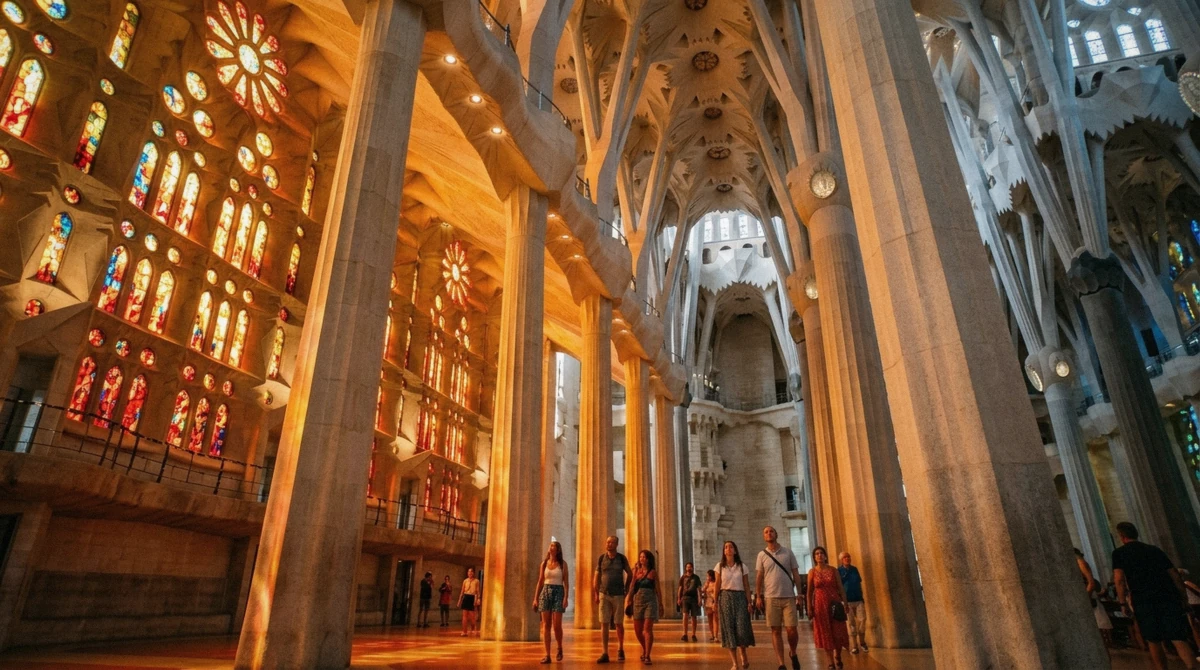
Gaudí set the colours by compass. The eastern windows, behind the Nativity side, are blues and greens; the western ones, behind the Passion side, are oranges and reds. The sun moves that colour across the columns and the floor through the day, and the building looks like two different places depending on when you stand in it.
From 9:00 to about 11:00 the eastern glass throws cold blue light deep into the nave. From about 16:00 the western glass takes over and the same stone turns amber, which by 17:00 in summer reaches right across the transept.
Between those windows the interior is evenly lit and, to my eye, ordinary. If you only get one slot and you care about this, pick an end of the day, not the middle.
The Quiet Hour, 9:00 to 10:00
Since February 2026 the basilica runs a Quiet Hour every morning from 9:00 to 10:00. Audio guides need earphones and staff ask everyone to keep their voices down.
It has changed the first slot completely. The building was designed to be a church and for that hour it sounds like one, which makes it the slot I now recommend before any other, particularly in summer when the alternative is a full house at midday.
It does mean a live guide talks more quietly, so if you are on a guided visit at 9:00, stand close.
Which Day of the Week
Tuesday to Thursday are the lightest. Monday carries the weekend arrivals and Friday the weekend starters.
Saturday closes at 18:00 in every season, which in summer costs you the two best evening hours. Avoid it if the light is your reason for coming.
Sunday opens at 10:30, after the international Mass at 9:00. That Mass is free and open to anyone who queues for a seat, but it is a service and not a visit: you cannot tour the building on it, and the doors close once the seats are full.
Which Slot Suits You
If you are photographing the interior
take 9:00 for cold blue glass, or the last slot of a summer evening for amber. Never the middle of the day
If you are travelling with small children
book 9:00 on a weekday, when the building is quietest and everyone's patience is fresh
If you are here in July or August
the Quiet Hour or the 19:00 slot. Anything else means heat outside and a full nave inside
If you have one afternoon in Barcelona and no choice
take what is available and spend the extra time on the two free parks outside, where the facade views are
If you want the building at its emptiest
come on a Tuesday in late January at 9:00. Nothing else comes close
Booking, Dress Code and the Practical Traps
How Far Ahead to Book
Around 5 million people come through each year, and entry runs on 15-minute slots, so the calendar is the constraint rather than capacity. In July and August the morning slots go days ahead; in January they are usually there the day before.
In July and August, a specific morning slot needs one to two weeks. In May and September a few days is enough. From November to February you can often book the day before, and in January I have walked up and bought a slot for an hour later.
Whatever the month, the first and last slots of the day go before the middle ones. If either matters to you, that is the part to book early. Free cancellation up to 24 hours ahead on the tours I list makes holding a date cost nothing.
Can You Wear Jeans? Yes
Jeans are fine, and this question comes up constantly. What is not fine: bare shoulders, anything above mid-thigh, see-through fabric, swimwear, bare feet, and hats inside the nave and museum. The door staff enforce it every day of the summer, and the shops along Carrer de Mallorca sell a lot of emergency shawls in August.
Bring a layer even in July. The interior is cool, you stand still for long stretches, and the stone holds the night temperature well into the morning.
Bags go through a scanner at the entrance and large rucksacks go into lockers, so allow ten minutes for security on top of your slot time. The full timing breakdown has the rest of it.
So, When Should You Go?
Best overall: a weekday morning at 9:00 between November and February, in the Quiet Hour, with the eastern glass lit and the nave half empty.
Best in summer: the last slot of the evening, 19:00 or 19:15, when the western windows are at full strength and most of the day's crowds have gone.
Worst: a Saturday afternoon in August, arriving without a booked slot. Whichever you pick, the choice between a guide and the free audio app is a separate decision, and I have written up what a guide actually adds. Every option, with prices and ratings, sits on the comparison of guided visits and tickets.
Timing Questions People Actually Ask
Is it better to visit the Sagrada Família in the morning or the evening?
Morning for cold blue light from the eastern windows and the Quiet Hour between 9:00 and 10:00. Evening for warm amber light from the western windows, which is only available from April to September when the basilica stays open until 20:00. The middle of the day is the worst of both.
What day of the week is best to visit the Sagrada Família?
Tuesday to Thursday. Saturday closes early at 18:00 all year, which costs you the summer evening light, and Sunday does not open until 10:30 because of the 9:00 international Mass.
What is the best month to visit the Sagrada Família?
November, January or February for the smallest crowds and easy same-week booking, with the afternoon light arriving conveniently early. May and late October are the best compromise if you also want long days in the city.
Can you wear jeans to the Sagrada Família?
Yes. The dress code asks for shoulders and knees covered, no see-through fabric, no swimwear and no bare feet, and hats come off inside the nave and museum. Jeans meet all of that comfortably.
How many hours do you need at the Sagrada Família?
Ninety minutes on a guided visit, two to two and a half hours on your own, and three or more if you add a tower. Allowing three hours in total leaves time for the two parks outside where the facade views are.
What is the Quiet Hour at the Sagrada Família?
A daily hour from 9:00 to 10:00, in place since February 2026, when earphones are required for audio guides and visitors are asked to keep noise down. It is the calmest slot the basilica sells.
If you take one thing from this: book an end of the day, not the middle. A Tuesday at 9:00 in winter or a 19:00 slot in July will show you a building most visitors never see, and both cost exactly the same as the crowded hour at noon.